Product Overview
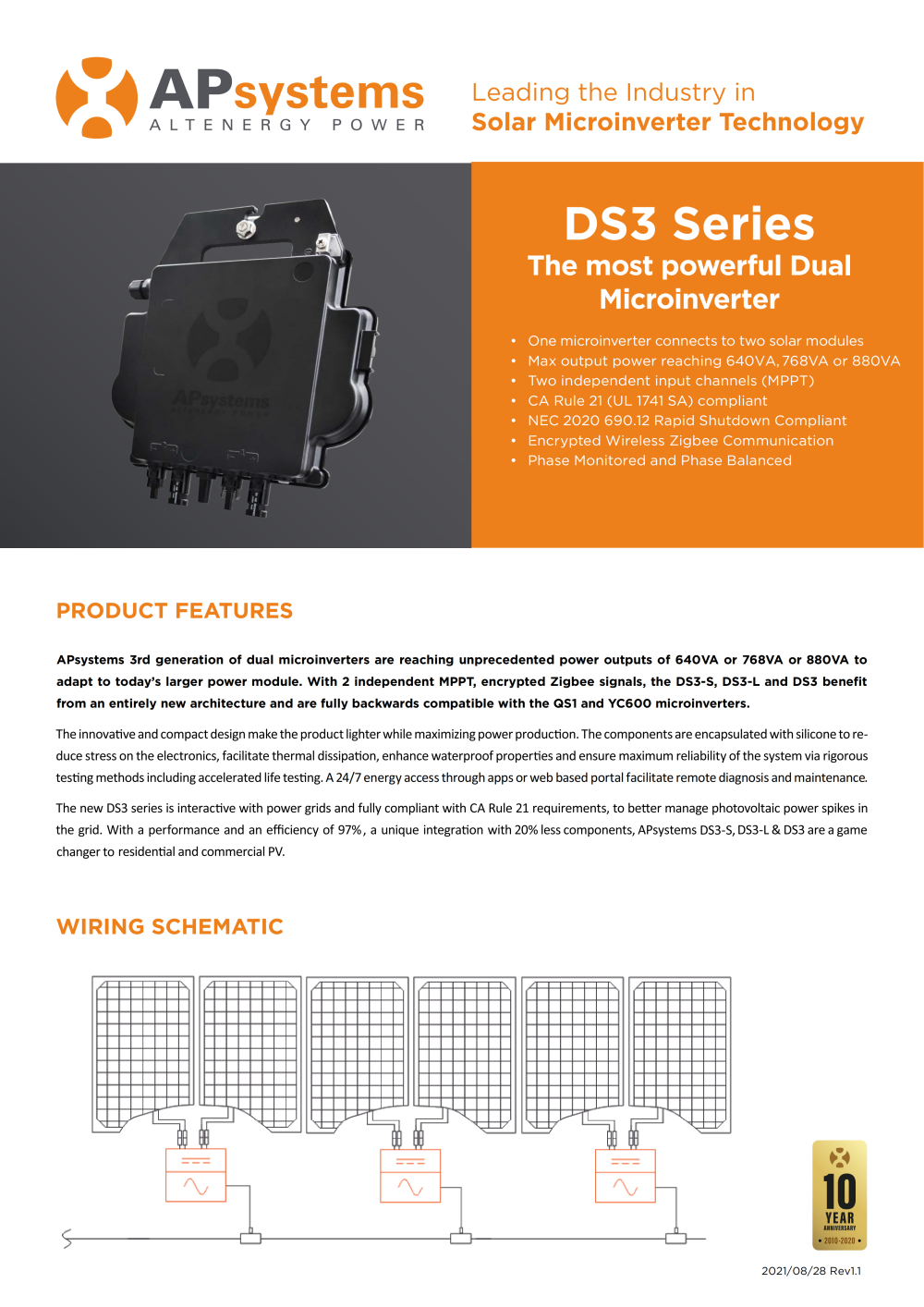
A dual-module microinverter rated at 768 VA. It converts DC power from two solar modules into grid-ready AC at 240 V or 208 V, so an array is built pair by pair rather than around one central inverter. Recommended module power runs from 300 W to 660 W+ per input, which covers the usual residential modules and a commercial solar panel sitting near the top of that range. Homes with split roof planes, add-on arrays and smaller commercial rooftops are the natural fit. Each unit is mounted on the racking directly beneath the two modules it serves, so the roof surface itself is left untouched.
Key Features
- 97% peak efficiency keeps conversion losses low, so more of what the two modules produce reaches the service panel.
- NEMA 6 enclosure, built for mounting outdoors on the racking where driven rain, irrigation overspray and wash-down are normal exposure.
- Stäubli MC4 DC connectors, the mating hardware used on most microinverters for solar panels, so leads and replacement connectors are easy to source.
- Listed for interconnection: UL1741, CSA C22.2 No.107.1-16, CA Rule 21 and FCC — the listings inspectors and utilities ask for on a grid-connected permit.
Branch Planning
- Group the units into AC branches before you pull cable: no more than 5 units on a 20 A branch, or 7 on a 30 A branch.
- Size the AC run for a single-phase 240 V or 208 V service. The same unit covers both, so the branch follows the building's supply rather than the other way around.
- Label each branch at the sub-panel so service work later can be traced unit by unit without opening the array.
- Keep headroom on the final branch if more pairs are likely to be added, because an extra pair means an extra unit on that branch.
Applications
- Split and multi-plane roofs: panels facing two or three directions each keep their own conversion, so a roof that never suited one long string layout still works pair by pair.
- Add-on sections: modules added on a garage or extension connect to their own units, so the new section does not have to match the original array's module count or wiring.
- Partly shaded roofs: when shade falls on one pair, the rest of the roof keeps producing, because the loss stays with the two modules wired to that unit.
- Light commercial rooftops: 208 V services are common in commercial solar panel systems, and a grid tie microinverter layout goes in pair by pair exactly as it does on a house — the branch count is what changes.
Mounting & Commissioning
- Plan the pairings first. In a microinverter solar system each unit sits beneath the two modules it serves, so check that both DC leads reach it without tension.
- Fix the enclosure to the racking under the modules rather than to the roof deck, clear of anything that traps heat around it.
- Make the two DC connections, then check polarity and open-circuit voltage on each input before the AC side is energised.
- Energise the branch, confirm the AC output at the service panel, and commission the monitoring link, noting the readings for the handover pack.
Scale & Supply Capability
We bring together the solar equipment homeowners and installers ask for — N-type bifacial panels, APsystems and Enphase microinverters, RUIXU LiFePO4 storage, and IronRidge roof mounting — in one place. From our Southern California warehouse we serve residential and commercial projects, with local pickup that keeps orders moving fast. Tier 1 components, UL, TUV and CE listed models, and domestic-content options are held in stock, from single units to full pallet quantities. Our team helps you match models and specs to your project, and every covered item carries its stated warranty.
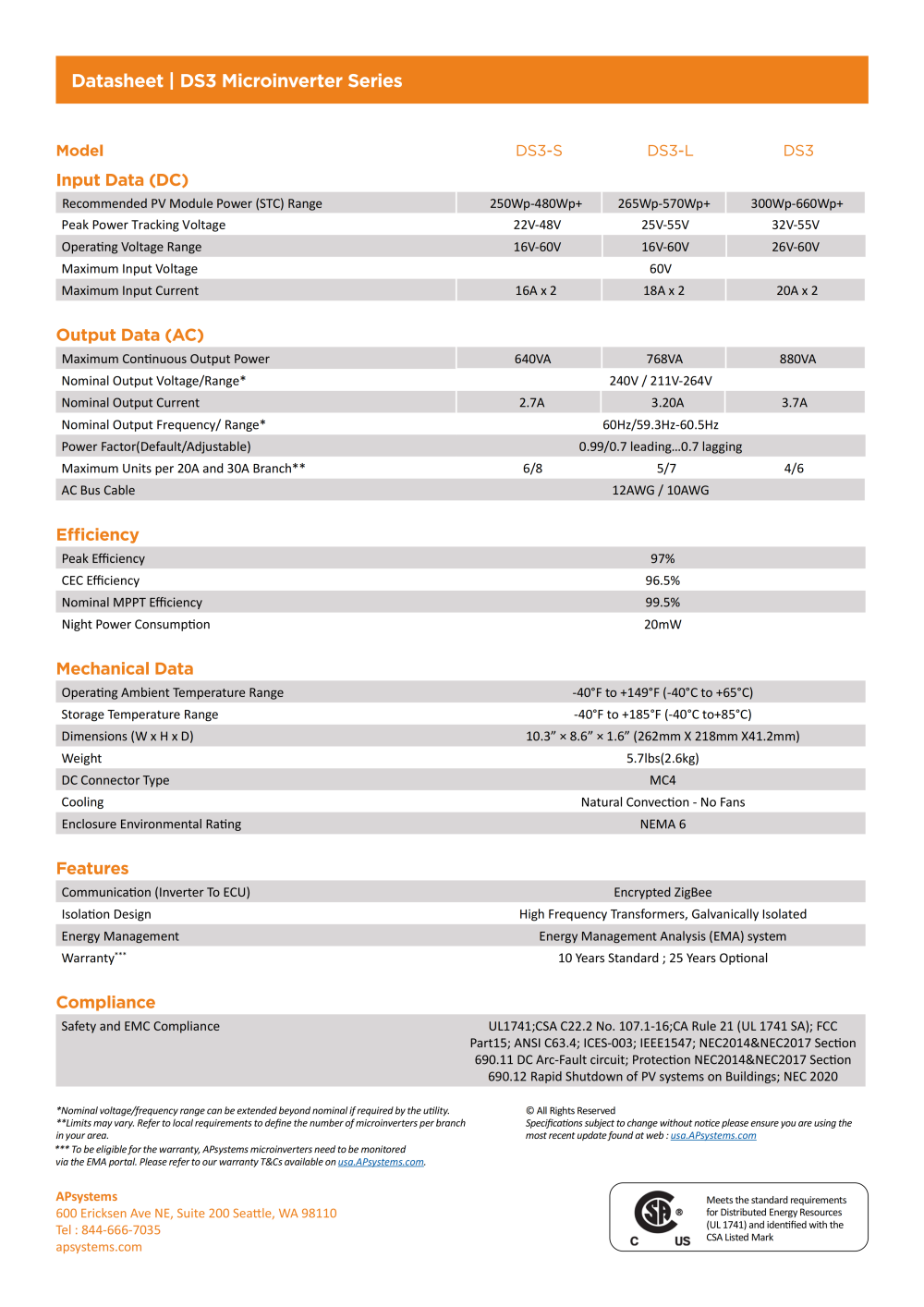
| Specification |
Details |
| Manufacturer |
APsystems |
| Model |
DS3-L-NA |
| Maximum Output Power |
768 VA |
| Recommended Module Power |
300W – 660W+ |
| Maximum Input Voltage |
60 V |
| Maximum Input Current |
20 A × 2 |
| Peak MPPT Voltage Range |
32V – 55V |
| MPPT Voltage Operating Range |
26V – 60V |
| Nominal AC Output Voltage |
240 V |
| Nominal Output Current |
3.20 A |
| Nominal Output Frequency |
60 Hz |
| Power Factor |
0.99 (adjustable) |
| Maximum Units per Branch |
5 (20A circuit) / 7 (30A circuit) |
| Peak Efficiency |
97% |
| Operating Temperature |
-40°F to 149°F (-40°C to 65°C) |
| Dimensions |
10.3 × 8.6 × 1.6 in |
| Weight |
5.7 lb |
| DC Connector |
Stäubli MC4 |
| Enclosure Rating |
NEMA 6 |
| Communication |
Encrypted ZigBee |
| Compliance |
UL1741, CSA C22.2 No.107.1-16, CA Rule 21, FCC |
FAQ
Q1. How do I match panels to this microinverter?
The two inputs are rated for modules in the 300 W–660 W+ range, and each input accepts up to 60 V and 20 A. For the most reliable tracking, choose modules whose peak power point sits between 32 V and 55 V. If a module falls outside those limits, send us the data sheet and we will check the pairing before you order.
Q2. Is this a grid tie microinverter that works on 208 V as well as 240 V?
Yes. Nominal AC output is 240 V / 208 V at 60 Hz, so the same unit serves a home service and the 208 V connections common in light commercial solar panel systems. Power factor runs at 0.99 and is adjustable if the utility or inspector asks for a specific setting on the interconnection form.
Q3. How much room and weight does each unit add?
Each unit measures 10.3 × 8.6 × 1.6 in and weighs 5.7 lb, and it mounts on the racking under the modules rather than on the roof deck or the array face. In a microinverter solar system, that extra weight per unit is small next to the modules it serves and adds nothing to the visible roof profile.
Q4. How is monitoring and communication handled?
Communication runs over encrypted ZigBee, so production data travels wirelessly from each unit. That means a commercial solar panel roof with units spread over several areas does not need a separate data cable run to every enclosure, and there is one less thing to fault-find later.
Q5. What temperatures can the unit handle?
Operating range is -40 °F to 149 °F (-40 °C to 65 °C), wide enough for roof decks that bake in summer and for installations that see hard winter cold. The sealed enclosure stays weather-tight through both ends of that range, so the unit does not need shading or a sheltered position.
Q6. How do I confirm which DS3 unit my design calls for?
Match the model code and the output rating on the drawing: this is the 768 VA, 240 V / 208 V dual-module unit. Other units in the DS3 family carry different ratings, so the model code plus the VA figure is the quickest check against a bill of materials. If a revised drawing is unclear, send it over and we will confirm.


