Product Overview
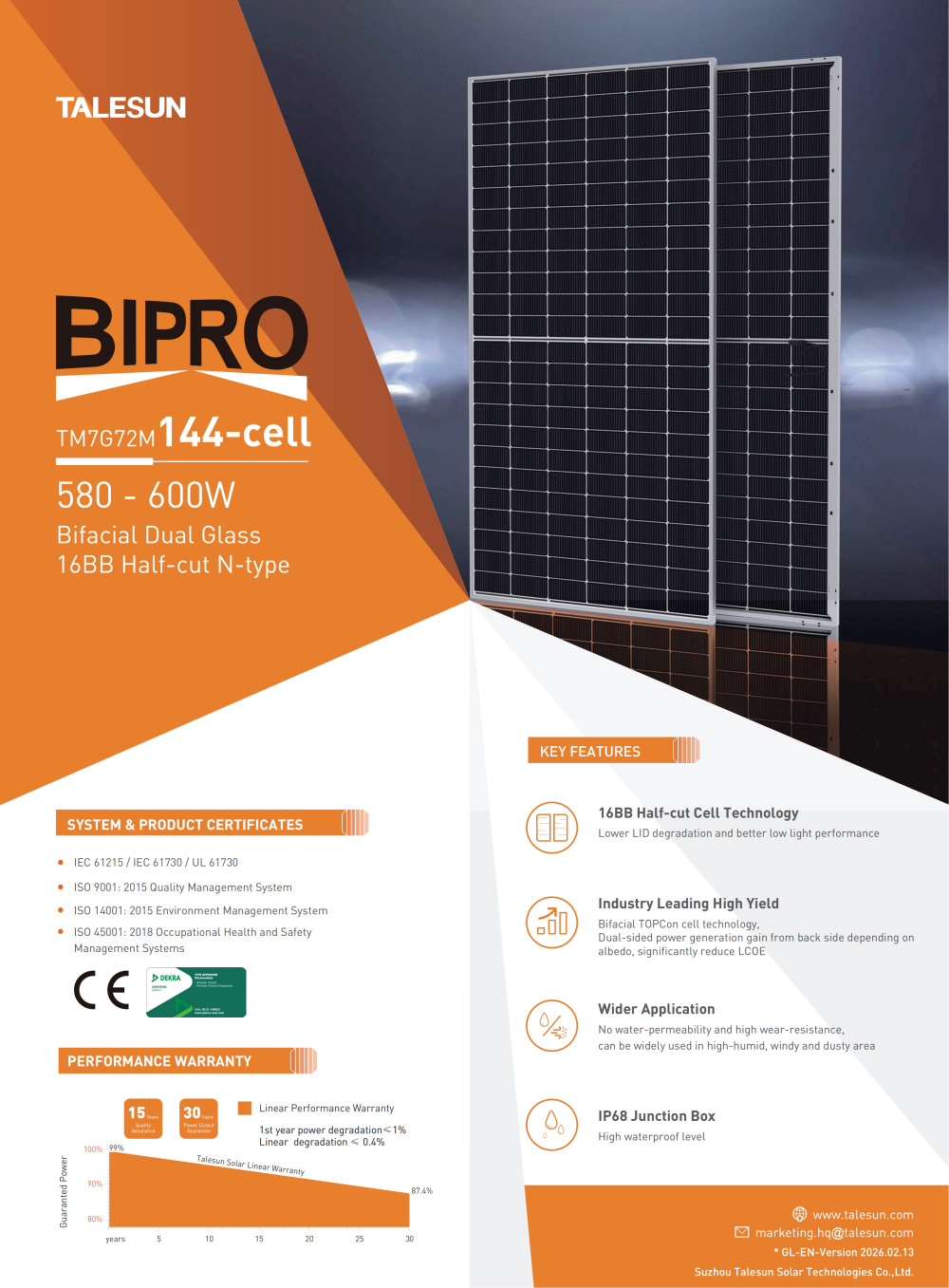
The Talesun BIPRO 590W is a high-output bifacial solar panel for projects that need more watts from the same roof area. Its 590 W front rating means fewer modules across an array, which matters on commercial rooftops with fixed usable space and on houses where the rail runs are already tight. It is a 72-cell module built around N-Type TOPCon cells, and it suits pitched roofs, flat commercial decks and ground-mount racks alike. If you are weighing it against a lower-wattage module on the same racking, this is the one that gets you to your target array size with fewer pieces to bolt down, wire and commission.
Key Features
- More power from the same footprint. Ordering a 590 W solar panel instead of a lower-rated module lifts the DC size of an array without adding rails, clamps, cable runs or roof penetrations — and the labour saved usually outlasts the hardware saving.
- Sealed junction box with bypass diodes. The IP68-rated box keeps moisture and dust away from the connections, while three bypass diodes let current route around a shaded section instead of dragging the string down.
- Rated for extreme climates. The module is specified to keep working from −40 °C winters through +85 °C rooftop summer heat, so the same part suits northern snow-belt sites and southwestern desert arrays.
Specifications
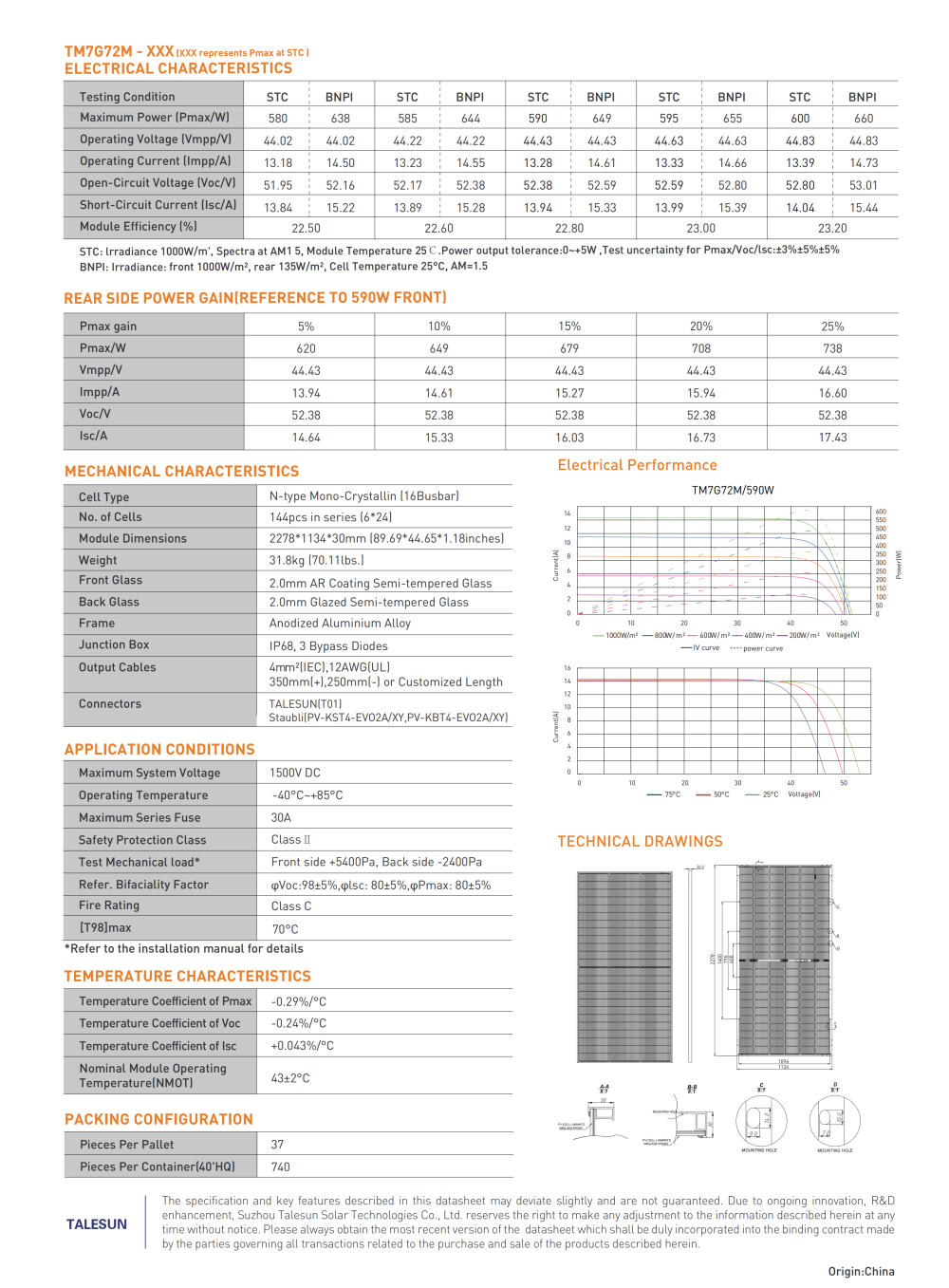
| Voltage / current at max power (Vmpp / Impp) |
44.43 V / 13.28 A |
| Open-circuit voltage / short-circuit current (Voc / Isc) |
52.38 V / 13.94 A |
| Maximum system voltage |
1500 V DC (IEC/UL) |
| Module dimensions |
2278 × 1134 × 30 mm (89.69 × 44.65 × 1.18 in) |
| Mechanical load |
5400 Pa front / 2400 Pa back |
| Power tolerance |
0 to +5 W |
Cell, Glass & Frame Build
This is a monocrystalline solar panel built on N-Type TOPCon cells, cut in half and arranged as 144 pieces across a 6 × 24 grid, with 16 busbars per cell for even current collection. Half-cut geometry shortens the current path inside the module, which trims resistive losses and spreads the load across more conductive paths. Both faces are glass: 2.0 mm AR-coated semi-tempered glass at the front and 2.0 mm glazed semi-tempered glass at the back, so neither side is a weak point against weather or reflected light. The anodized aluminium alloy frame takes the mounting loads and stands up to coastal air and industrial atmospheres.
Applications
- Commercial rooftops. On an industrial or retail roof the usable area is fixed, so the goal is more kilowatts per square metre rather than more panels. A commercial solar panel at 590 W keeps the array inside the parapets and setbacks while trimming the number of rail runs and penetrations.
- Homes with a compact roof plane. A short south- or west-facing slope still reaches the household's target array size, and because fewer modules cover the same area the finished layout looks less crowded from the street.
- Warehouse, depot and carport roofs. These are the long, uninterrupted surfaces a solar panel for commercial use is usually specified for — fewer units to lift, clamp and wire, and fewer connections to check during commissioning.
- Ground mounts and elevated racks. Open layouts give you room to set tilt and row spacing properly, which is where a higher-output module reduces the number of posts, rails and trenches the project has to build.
Scale & Supply Capability
We bring together the solar equipment homeowners and installers ask for — N-type bifacial panels, APsystems and Enphase microinverters, RUIXU LiFePO4 storage, and IronRidge roof mounting — in one place. From our Southern California warehouse we serve residential and commercial projects, with local pickup that keeps orders moving fast. Tier 1 components, UL, TUV and CE listed models, and domestic-content options are held in stock, from single units to full pallet quantities. Our team helps you match models and specs to your project, and every covered item carries its stated warranty.
|
Testing Condition
|
STC
|
|
Maximum Power (Pmax/W)
|
590
|
|
Operating Voltage (Vmpp/V)
|
44.43
|
|
Operating Current (Impp/A)
|
13.28
|
|
Open-Circuit Voltage (Voc/V)
|
52.38
|
|
Short-Circuit Current (Isc/A)
|
13.94
|
|
Module Efficiency (%)
|
22.80
|
|
Parameter
|
Value (STC: Irradiance 1000W/m², AM1.5, Module Temp 25°C)
|
|
Model Number
|
TM7G72M-590
|
|
Nominal Max. Power (Pmax)
|
590 W
|
|
Module Efficiency
|
22.8%
|
|
Optimal Operating Voltage (Vmpp)
|
42.66 V (for 580W) - 42.85V (for 590W)
|
|
Optimal Operating Current (Impp)
|
13.83 A (for 580W) - 13.93A (for 590W)
|
|
Open Circuit Voltage (Voc)
|
51.47 V (for 580W) - 51.67V (for 590W)
|
|
Short Circuit Current (Isc)
|
14.37 A (for 580W) - 14.47A (for 590W)
|
|
Cell Type
|
Monocrystalline Silicon (N-Type TOPCon, 16 Busbars)
|
|
Number of Cells
|
144 (6 x 24) Half-Cut Cells
|
|
Module Dimensions (L x W x H)
|
2278 x 1134 x 30 mm (89.69 x 44.65 x 1.18 inches)
|
|
Weight
|
31.8 kg (70.11 lbs)
|
|
Front Glass
|
2.0mm AR Coating Semi-tempered Glass
|
|
Back Glass
|
2.0mm Glazed Semi-tempered Glass
|
|
Frame Material
|
Anodized Aluminium Alloy
|
|
Junction Box
|
IP68-rated, 3 Bypass Diodes
|
|
Maximum System Voltage
|
1500 V/DC (IEC/UL)
|
|
Operating Temperature
|
-40°C to +85°C
|
|
Mechanical Load (Front/Back)
|
5400 Pa / 2400 Pa
|
|
Power Tolerance
|
0 ~ +5W
|
FAQ
Q1. How much extra output does the bifacial solar panel design add?
That depends on what sits behind the array. A dark composite roof reflects very little, while a light membrane, gravel ballast or an open rack sends noticeably more light to the rear glass. Tilt and mounting height matter as well, so the real contribution is worked out per project rather than quoted as one figure.
Q2. Is this panel meant for homes or for commercial roofs?
Both. Fewer, higher-output modules put more capacity on a commercial solar panel array than the same number of lower-output modules, yet the same unit suits a house with a short, narrow roof plane. It is a standard 72-cell module, so the rail spacing and clamps your crew already uses will fit it.
Q3. Does the panel need regular cleaning?
On a tilted array, rain does most of the work. Where dust, pollen or bird droppings collect, rinse with plain water and a soft brush in the cool part of the day, and skip abrasive pads and solvents. Once a year, check that the frame and junction box are clear of debris and that the mounting hardware is still tight.
Q4. How should this be handled on a large commercial roof?
Plan on two people per module for roof lifts and a hoist or crane for anything above a single storey, since a glass-glass laminate weighs more than a backsheet panel of the same size. On a solar panel for commercial use installation, staging modules near the lift point and working in rows keeps the crew moving without carrying panels the full length of the roof.
Q5. What is the difference between the 585 W and 590 W versions?
They share the same 72-cell BIPRO platform and the same dual-glass construction; the difference is the output bin the modules are sorted into. Choose the 590 W where you want the most power from each mounting position, and the 585 W where you are matching an array already built on the same platform. Both are monocrystalline solar panel builds with the same footprint.
Q6. Will this module work with the inverter I already have?
It is a DC module, so it runs with a standard string inverter or with per-panel microinverters. Match the string on voltage and current, and keep modules of different models on separate strings. If you are extending an existing array, match the new modules to the ones already on the roof or give them their own input.


